March
A festival of friendship.
MurungDreeThe music festivalThe valley
Myoko is the long friendship festival of the Apatani, who call themselves Tanii. It is kept in the villages of the Ziro valley, in Lower Subansiri. We are in one of those villages, Mudang Tage. The clan and the village keep Myoko. We are simply your hosts while you're here.
People call it a festival of friendship, and that is a fair way in. Households welcome the people they are bound to, and then they walk to those houses and are fed in return. The visiting is the heart of it. If you stay with us, we'll tell you what is happening that day, and where you're welcome to walk.
Whose turn
Not every March.
The valley does not celebrate Myoko together. The villages take it in three turns, so a household carries the full weight about once in three years, and spends the other two years walking to someone else’s door. Accounts differ on a name or two at the edge of a group. The shape that the valley itself repeats is this:
- Hong
- The largest village, on its own turn.
- Hari and Bulla
- One turn together. Some accounts place Tajang with them.
- Hija, Dutta, Mudang Tage, Bamin-Michi
- The third turn. This is the year that includes the house.
In 2018 the public days were with Hija, Mudang Tage, and Bamin-Michi. That is the group a guest at this house should ask about. A March when Hong is keeping Myoko is not a quiet month in the valley, but it is not Mudang Tage’s own hosting year. Ask the house which turn the year belongs to before you plan the trip around it.
How long
Longer than the public days.
The visible days sit in late March and run on into April. One Apatani account, written from Hari, puts the start on the evening of 20 March and carries the obligations through to the middle of April. The district’s own note says the friendship runs for nearly a month, from the end of March toward the end of April. A newspaper account from the valley speaks of about ten public days, often between 20 and 30 March. Those are not contradictions to tidy away. The preparation is longer than the days a visitor can see.
Timber for the lapang, the community platform, and for the babo, the tall ceremonial pole, is cut well before March. Clans repair the platform and raise a new pole. In the Hari account the platform is spoken of as male and the pole as female, and the trees that may be used are named and limited. There the eldest clan goes first, and the others follow. By the time a visitor sees a pole on the ceremonial ground, the village has already been at Myoko for months.
This is also the season when the new rice goes into the terraces. The prayers that sit inside Myoko are for the crop as well as for the bond between villages. The two are not separate errands.
What happens
The friends must be fed.
During the hosting days, houses stay open. A person can come in without the small negotiation that a closed door implies. That openness is the custom, not an invitation to treat a family room as a viewing gallery. The people being received are often biini ajing, the ritual friends from other villages, whose visit is owed and whose meal is part of the bond. Rice beer, meat, and the time it takes to sit down are the substance. A priest, the nyibu, chants. Pigs are offered. There is clan order in who moves, who cooks, and who is visited on which day.
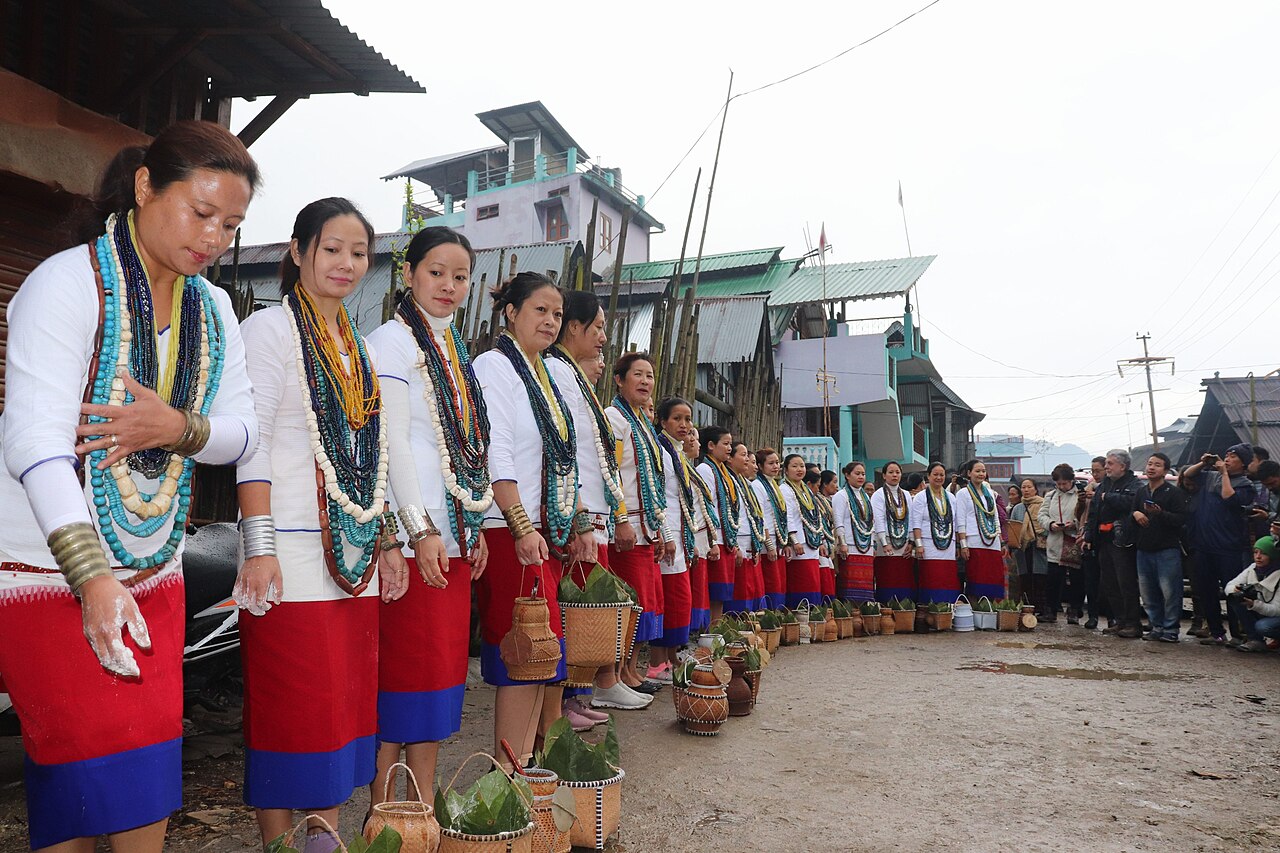
The line of women in the photograph, in white and red, with beads and cane baskets, is ceremonial dress for a public moment of Myoko. It is not a costume put on for a camera. Tiipé, the facial tattoos, and yaping hullo, the nose plugs, belong to older women. That marking stopped in the 1970s. The cloth and the beads did not stop.
There is no ticket and no stage. If you are staying with us in a hosting year, the village is busy with its own people, and it is a warm, full time. Please ask before you photograph a chant, a priest, or the inside of a house. People are happy to say yes, and it is perfectly all right if someone says no. We'll help you find a place to stand.
At the house
The rooms are still a home that week.
M.N is our family house on the lane, with the sign on the lower balcony. In a Myoko year for our group of villages, we are in the middle of it ourselves: meals, visitors, and the hours of the day. A room may still be free. If it is, we'd love to have you. If it isn't, we'll say so plainly.
Book a room before you travel, and tell us you're coming for Myoko. If it isn't Mudang Tage's turn that year, tell us that too. We'll let you know what the valley is doing, and how to enjoy it.
Myoko is its own week. Dree in July is the prayer for the rice. Murung is one household's celebration. The music festival is a visit that comes and goes. If you're not sure which one you're arriving for, ask us. We're happy to explain.
Myoko, March 2023: The Hagez, CC BY-SA 4.0. The groups of villages are the ones the valley’s own accounts repeat; Tajang is placed with Hari and Bulla in some of them and left out of others.
